Insight
How to Read Organizational Culture Through Data: A Practical Guide to Automating Employee Survey and Feedback Summaries
Nov 28, 2025


Why Is Employee Feedback Analysis So Challenging?
Hundreds to Thousands of Open Responses Are Unmanageable Manually
Corporate HR teams regularly conduct organizational culture diagnostics, satisfaction surveys, and VOC collections that include a vast volume of open-ended responses. A single survey may yield hundreds of responses, and organization-wide surveys can easily surpass thousands. The problem lies in the enormous time it takes for humans to read and summarize this text data manually. Because of diverse sentence structures, expression styles, and vocabulary choices, it is not easy to standardize the analysis. As a result, there's a high risk of missing or misinterpreting important feedback. This is especially problematic when feedback directly ties to employee experience (EX), organizational culture, or work method improvements.
Subjectivity in Emotion and Topic Classification Undermines Consistency
One of the most difficult aspects of handling feedback data is eliminating subjectivity. Even within the same HR team, one analyst may classify a feedback statement as positive, while another may see it as negative. This undermines the consistency of reports, diagnostics, and leadership insights. When you want to track organizational change across years or compare across departments, the same standards and perspectives must be applied. However, manual analysis inherently lacks reproducibility and comparability.
How Automated Feedback Summary Works
How AI Classifies Text-Based Responses by Topic and Sentiment
The core of automated survey systems is classification technology based on Natural Language Processing (NLP). It breaks down user-written text responses by sentence, and then assigns each sentence a topic tag (e.g., compensation, communication, leadership) and an emotion tag (positive/negative/neutral). For example, a response like "There's a lack of feedback on work performance" is tagged with the topic "communication" and a negative sentiment. This process can handle thousands of entries in minutes and ensures consistency through repeatable application.
Logic for Extracting Repeated Issues, Sentiment, and Topic-Based Keywords
Automated feedback analysis goes beyond simple classification to quantitatively identify frequently mentioned issues in the organization. For example, if keywords like "performance evaluation," "salary increase," or "remote work" appear above a certain frequency, they are highlighted as major issues. Sentiment proportions for each issue (positive/negative) are also visualized. This allows you not only to see which topics are frequently mentioned, but also how they are generally perceived.
Structure for Deriving Summary Insights by Department and Organization
Automated analysis works not only at the full-organization level but also across departments, teams, and divisions. It identifies the most mentioned issues, high-negative sentiment topics, and significant change points for each unit. These insights are immediately applicable in real-world contexts such as leadership reporting, organizational workshops, or OKR planning.
The Benefits of Adopting Automated Analysis
Dramatic Reduction in Report Writing Time and Higher-Quality Insights for Leadership
Organizations that adopt AI-based feedback analysis systems can generate executive summary reports within hours after survey closure. Previously, HR managers had to manually read individual responses or extract arbitrary samples to generate insights. Now, both quantitative and qualitative insights can be consolidated across all data. Report quality improves while the time required can be reduced by more than 90%.
Results Automatically Reflect Anonymity and Sensitive Feedback Standards
Feedback often contains sensitive information. The analysis system de-identifies names, emails, and specific team names, and filters out profanity, discriminatory language, or violent expressions based on predefined rules. This ensures that feedback reports used for leadership, company-wide sharing, or internal boards maintain both quality and ethical standards.
Quickly Identify Departmental Problem Areas and Priority Issues
Analyzing feedback helps identify improvement priorities by team or department. For instance, Team A might struggle with "excessive workload," while Team B highlights "lack of transparency in performance incentives." By comparing different departments' problems and mapping them against shared organizational issues, leadership can better allocate resources and prioritize initiatives.
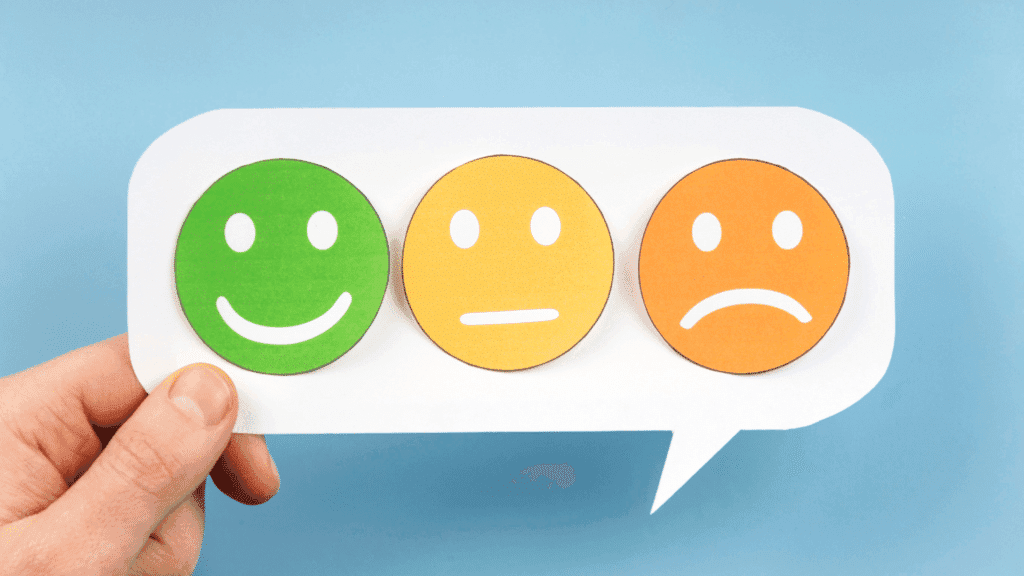
What Sets Ryntra’s Feedback Summary Solution Apart
Secure On-Premise Analysis That Prevents Data Leakage
Ryntra supports on-premise analysis environments for organizations with high-security requirements. Unlike SaaS-based systems that require uploading data to external servers, this structure allows AI analysis to be run on the corporate intranet. This prevents leaks of personal and sensitive information, making it particularly advantageous for security-sensitive and regulated institutions.
Support for Various Text Formats and Anonymity Protection Options
Beyond survey responses, Ryntra supports integrated analysis of email feedback, anonymous board posts, and Slack VOCs. Each data source can be processed with filters that remove identifiable information. This makes the system adaptable to the variety of feedback sources encountered in actual work environments.
Auto-Generated Summary Reports That Highlight Key Messages
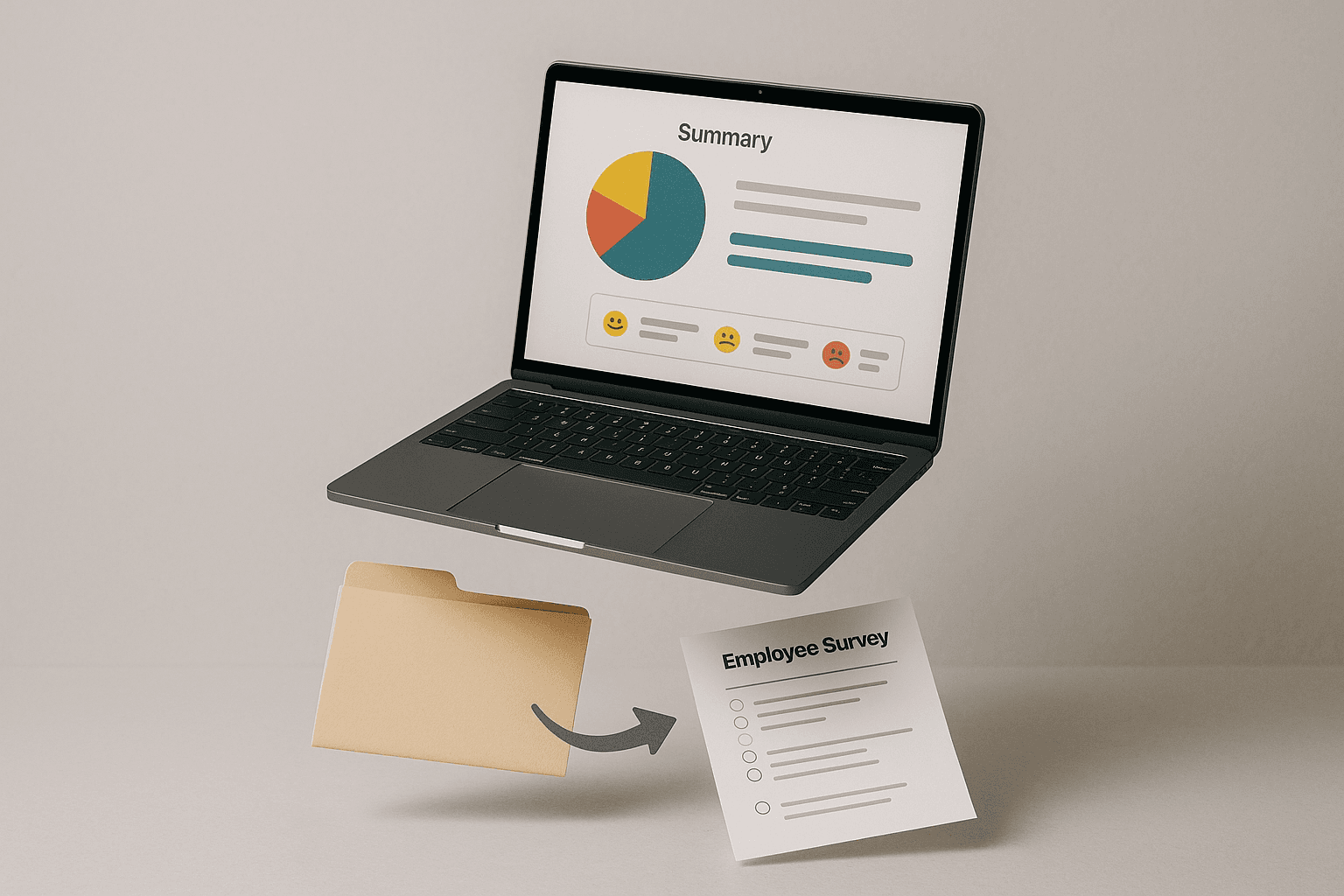
Ryntra's outputs go beyond raw data and generate leadership-ready snapshot reports. These include "Top 5 Mentioned Issues," "Emotional Trend Graphs," "Sentiment Heatmaps by Department," and "Topic-Based Keyword Clouds." These visual summaries are automatically generated and can be shared immediately without manual formatting.
Pre-Implementation Checklist
Survey Item Design and Open-Ended Response Collection Method
The effectiveness of automation hinges on survey design. Open-ended response fields should be broad enough and not limited to narrow topics. For example, "Please share any thoughts on our communication style" collects broader insights than "Please list complaints about our meetings."
Definition of Analysis Standards (Categories, Sentiments, Keywords)
For consistency in analysis, it is crucial to define feedback categories and sentiment taxonomy in advance. For instance, you might categorize topics into leadership, career growth, compensation system, and work-life balance. Sentiments might go beyond positive/negative/neutral to include subcategories like "gratitude," "criticism," or "suggestion," enabling richer insights.
Define Report Audience and Purpose
How the report is constructed depends on its audience and purpose. For C-level leaders, concise, metric-focused summaries are best. For company-wide sharing, a tone that emphasizes positive sentiments is more effective. Thus, it's essential to define use scenarios and target readers ahead of time.
Practical Application Scenarios
Case: Automated Summary of Organizational Culture Survey Results
A global manufacturing company conducts biannual organizational culture surveys, collecting over 6,000 open-ended responses each time. Previously, it outsourced analysis to consulting firms, requiring over three weeks. With Ryntra, this is now processed internally within 48 hours. The visualized emotion distribution and topic trends help business unit leaders autonomously diagnose issues and design action plans.
Case: Generating Leadership Meeting Insights Reports
A financial services firm uses quarterly feedback data to monitor organizational change in C-level meetings. Ryntra's reports are generated as 3–5 page PDF executive summaries, showing repeated issues, negative sentiment trends, and positive case highlights. Leadership meetings have shifted toward more concrete problem-solving.
Case: Combined Quantitative and Qualitative VOC Analysis
An IT company links customer center VOC data with internal employee surveys for annual feedback reviews. Ryntra extracts common keywords and emotional contexts from both text data sources to identify overlapping concerns. For instance, delays in a specific service or communication breakdowns highlighted by both employees and customers become top improvement priorities. This supports integrated enhancements across Customer Experience (CX) and Employee Experience (EX).
Conclusion: The Power of AI in Turning Feedback Into Actionable Data
Rapid, Accurate Feedback Interpretation Accelerates Organizational Change
Surveys and feedback are essential indicators of an organization’s internal health. How quickly and accurately these signals are interpreted can dramatically affect the pace of change. Automated feedback analysis is not merely a tool for operational efficiency but a strategic foundation for deriving insights. In fast-moving or uncertain environments, speed of feedback interpretation can be a competitive edge.
Smart Feedback Automation With Ryntra
Ryntra offers a solution built with deep understanding of real-world HR workflows. With accurate analysis, practical applicability, and high security, it processes open-ended feedback at scale and generates executive summaries tailored for leadership. If you're ready to transform how your organization understands and acts on feedback, Ryntra can be your launch point.
Recommended Content